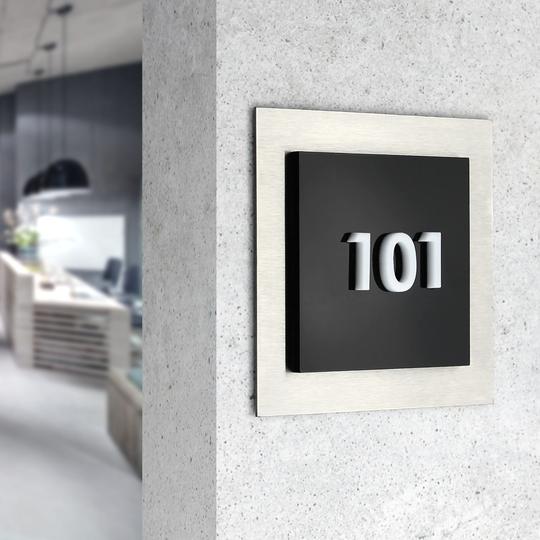
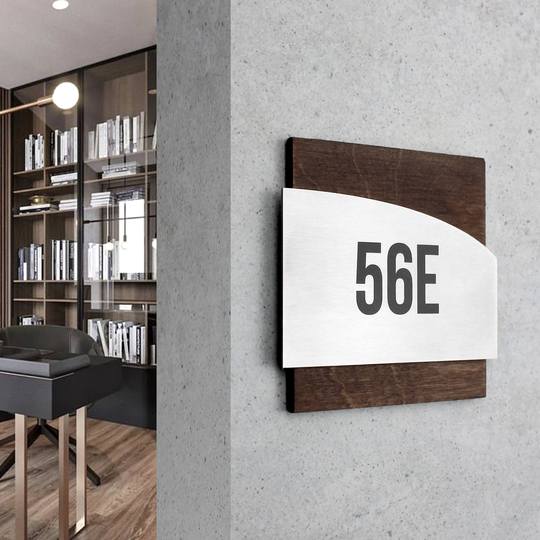
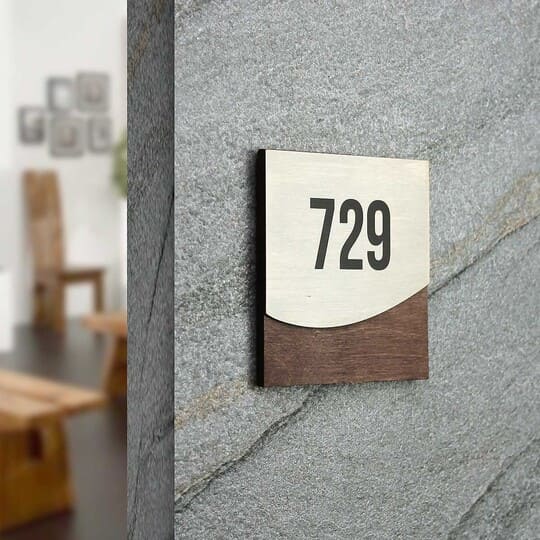
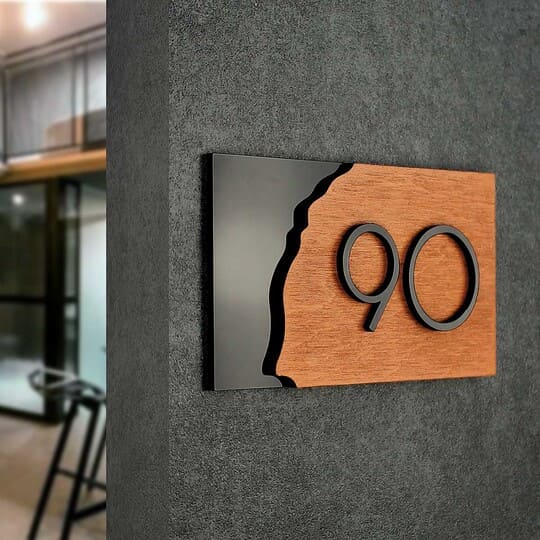


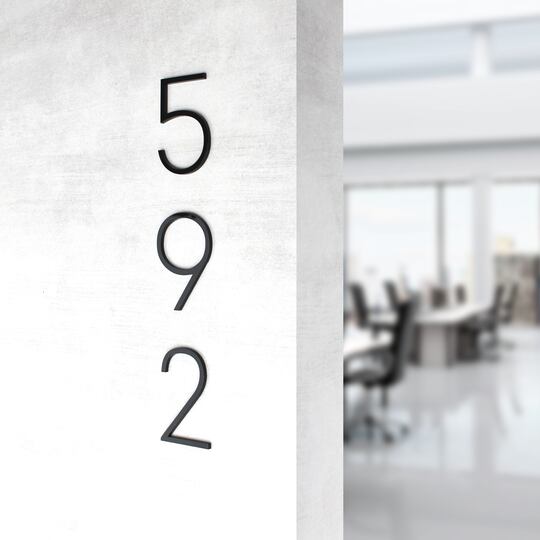





by Olena Zadniprovska
Which Rooms Require ADA Signs?
The 2010 ADA Standards for Accessible Design require tactile, Braille identification signs for permanent rooms and spaces — restrooms, stairwells, mechanical rooms, numbered offices and hotel rooms — whenever an identification sign is provided, and they separately require tactile EXIT signage at exit doors. The Standards do not require a sign on every door in a building: directional and informational signs only need to meet visual requirements, and several sign types are exempt entirely. Understanding this "required when provided" distinction is the first step to auditing a building correctly.
Quick Summary:
- Identification signs for permanent rooms and spaces must include tactile characters and Braille if such a sign is provided (§216.2).
- Doors at exit stairways, exit passageways, and exit discharge must carry tactile EXIT signage where codes require exit signs (§216.4.1).
- Restrooms and bathing rooms need the International Symbol of Accessibility when not all facilities are accessible.
- Directional and informational signs are visual-only, no Braille required (§216.3, §703.5).
- Building directories, occupant nameplates, and signs used for seven days or less are exempt from ADA signage requirements (§216.1, Exceptions 1 and 3).
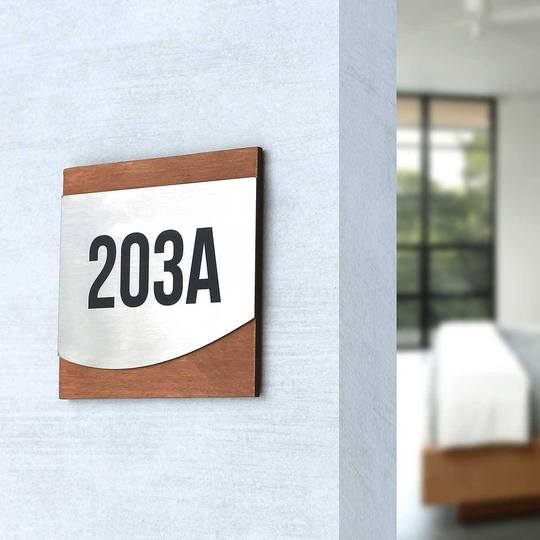
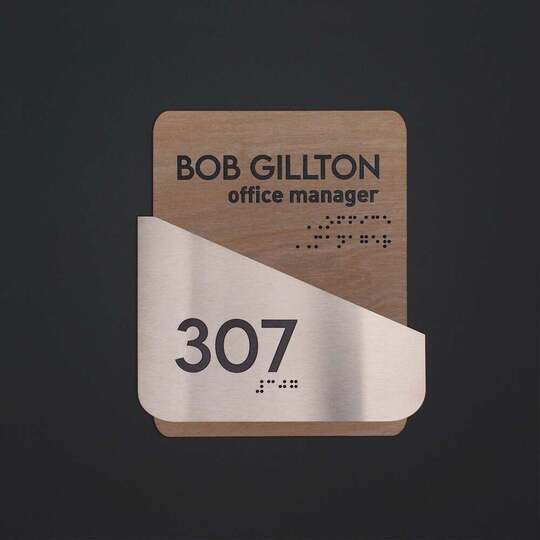
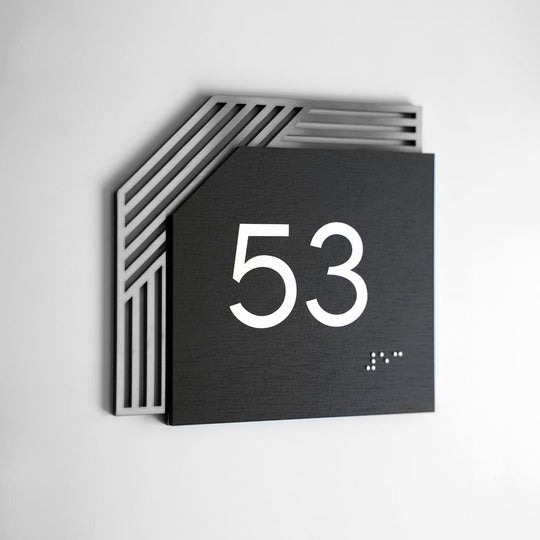
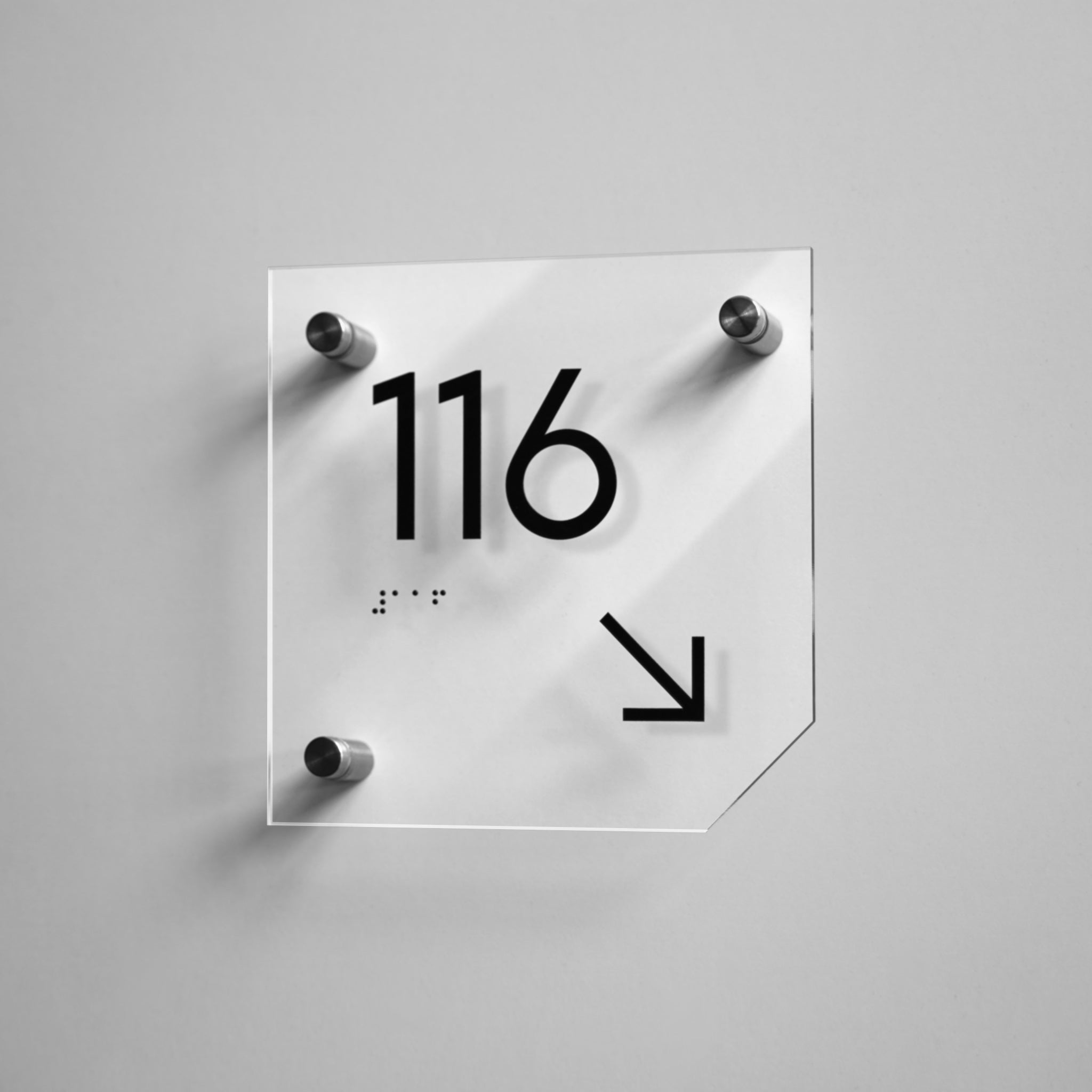
Room identification sign displaying a room number, text, and Braille for an office entrance:
How ADA Sign Requirements Work
The 2010 ADA Standards for Accessible Design, published by the U.S. Department of Justice (DOJ), do not require signs at every door. Under §216.2 of the 2010 ADA Standards, signs that identify permanent rooms and spaces must include both tactile characters and Braille. The Standards regulate identification signs once they are installed rather than requiring a sign at every door, as explained in the U.S. Access Board, Chapter 7: Signs. For a practical overview of these requirements and the different types of ADA signs used for permanent room identification, see our guide to ADA compliant door signs.
Some signs are mandatory regardless of whether a business chooses to install them:
- Tactile EXIT signs at doors leading to exit stairways, exit passageways, and exit discharge where required by code (§216.4.1).
- The International Symbol of Accessibility (ISA) at accessible restroom and bathing room entrances, plus directional signs to the nearest accessible facility when not all restrooms or bathing rooms are accessible.
- Tactile floor-level signs at elevator hoistway entrances are required by §407.2.3.1. Stairwell floor identification signs are generally required by applicable building codes. Once installed, these identification signs must comply with the ADA technical requirements for tactile characters and Braille under §§216.2 and 703.
A third category — directional and informational signs — must meet only the visual requirements of §703.5 and does not require Braille (§216.3). These three categories — required if provided, mandatory, and exempt — form the basis of the room-by-room examples below.
What Is a Permanent Room Under the ADA?
Definition: A permanent room or space is not defined as a standalone term in the 2010 ADA Standards. The U.S. Access Board explains that §216.2 applies to room names, numbers, and other designations that are unlikely to change over time, such as restrooms, stairwells, mechanical rooms, or numbered offices.
As a practical industry guideline, facility managers often treat spaces with fixed walls or partitions as permanent. However, the determining factor is whether the room's name, number, or designation is intended to remain the same over time, rather than how often the activities inside the room change.
Signs used for seven days or less are exempt from the ADA signage requirements (§216.1, Exception 3). For example, a temporary sign on a conference room door for a single afternoon does not require tactile characters or Braille, even though the room itself is permanent.
Which Rooms Must Have ADA Signs?
If you're wondering what rooms need ADA signs, the table below maps common room and sign types to their requirement status under the 2010 ADA Standards.
Table 1. Room Type: Is an ADA Sign Required?
| Room or space | Sign requirement | Tactile + Braille? | Standard reference |
|---|---|---|---|
| Restroom / toilet room | Required if not all restrooms accessible (ISA) | Tactile + visual | §216.2 |
| Bathing room | Required if not all bathing rooms accessible (ISA) | Tactile + visual | §216.2 |
| Exit door (stairwell, passageway, discharge) | Required outright | Tactile + visual | §216.4.1 |
| Stairwell floor-level identification | Required where applicable building or life-safety codes call for it | Tactile + visual | Applicable building or life-safety code; §216.2 and §703 apply to the sign |
| Elevator hoistway floor designation | Required | Tactile + visual | §407.2.3.1 |
| Existing accessible elevator ISA | Conditional | ISA | §216.7 |
| Directional sign to elevators | Visual only, if provided | Visual only | §216.3 |
| Hotel room / suite number | Regulated if provided | Tactile + visual | §216.2 |
| Office / room number | Regulated if provided | Tactile + visual | §216.2 |
| Conference room | Regulated if provided | Tactile + visual | §216.2 |
| Mechanical room | Regulated if provided | Tactile + visual | §216.2 |
| Electrical room | Regulated if provided | Tactile + visual | §216.2 |
| Storage room | Regulated if provided | Tactile + visual | §216.2 |
| Break room / kitchen | Regulated if provided | Tactile + visual | §216.2 |
| Lobby (directional) | Visual only, if provided | Visual only | §216.3 |
| Building directory | Exempt | Exempt | §216.1, Exception 1 |
| Occupant nameplate | Exempt | Exempt | §216.1, Exception 1 |
| Temporary event room sign | Exempt (≤7 days) | Exempt | §216.1, Exception 3 |
Restrooms and Bathing Rooms
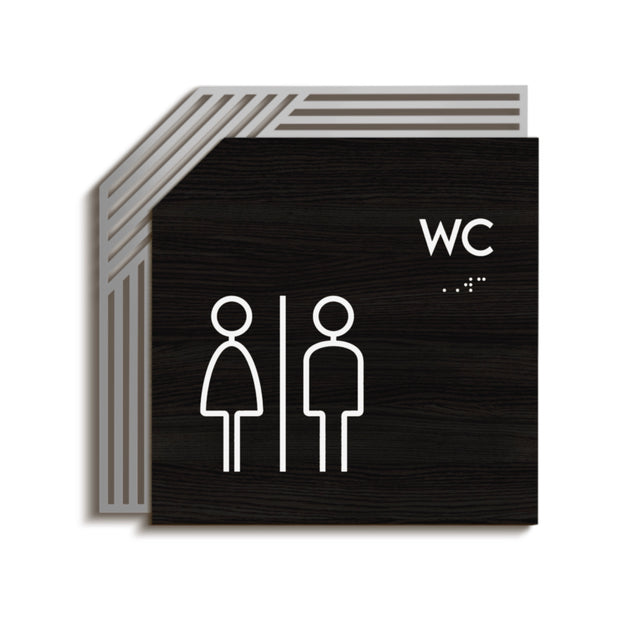
Restrooms and bathing rooms are one of the clearest cases where signage is required outright. If not all restrooms are accessible, accessible ones must display the International Symbol of Accessibility (ISA), with directional signs leading to the nearest accessible facility. When a pictogram identifies a permanent room or space, it must be placed within a field at least 6 inches (150 mm) high (§703.6.1).
This minimum applies to the pictogram field, not to the overall sign, and does not automatically apply to the ISA. For examples of room-identification and accessibility formats, see our restroom signs collection. ADA bathroom sign requirements also require tactile characters where applicable. For a detailed overview of restroom sign requirements, including sign types and design options, see our separate guide.
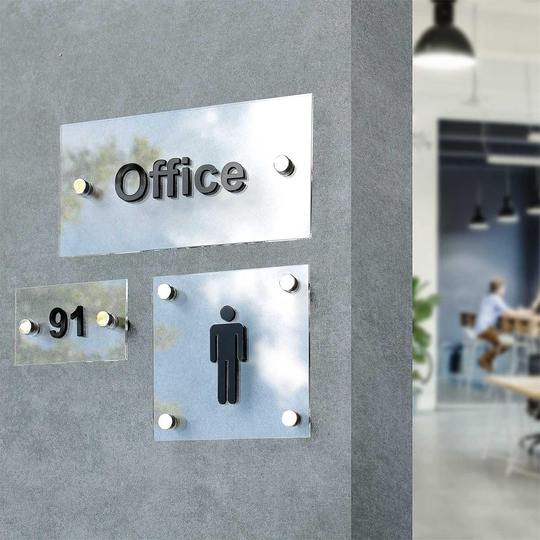
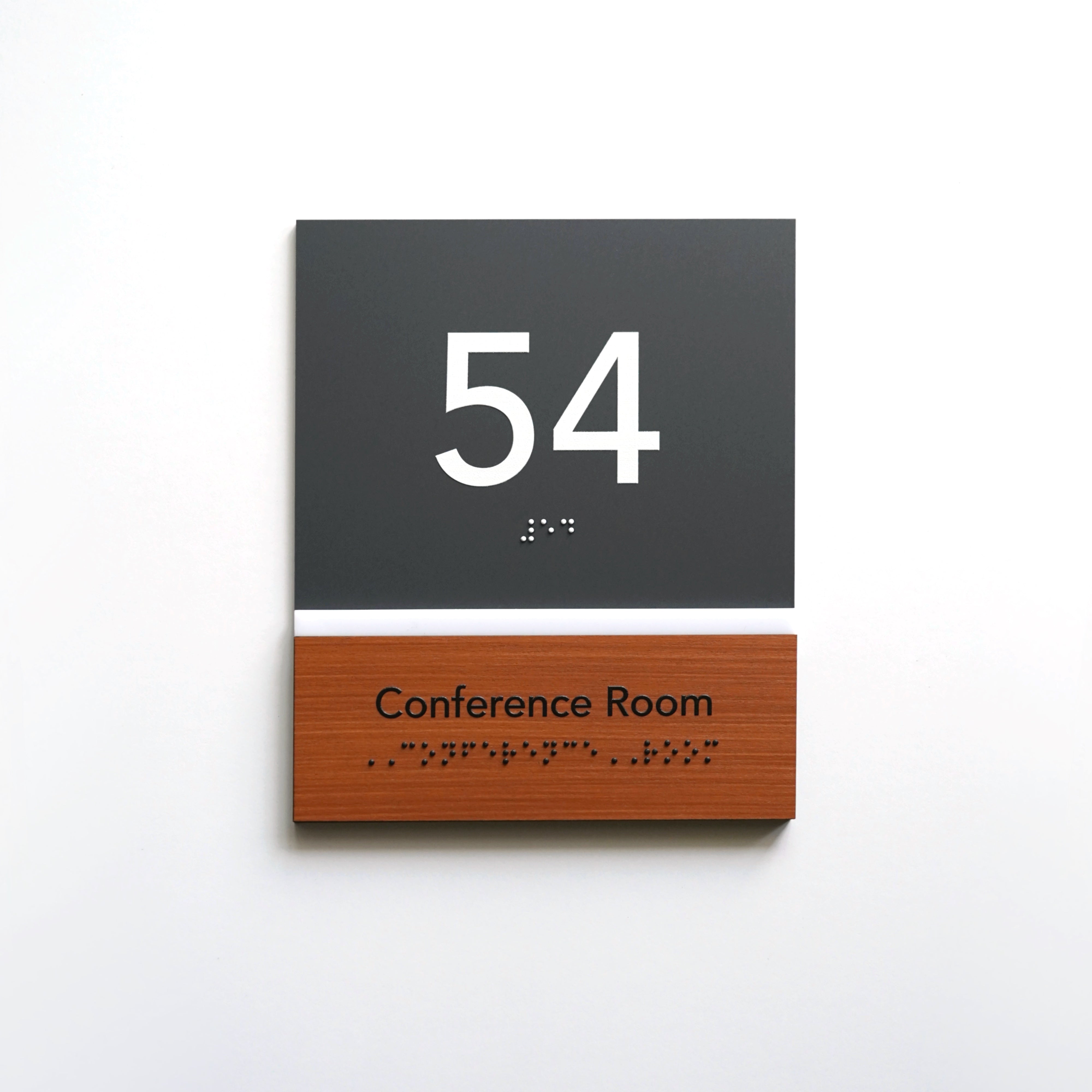
Restroom identification sign featuring tactile elements, Braille, and accessibility pictograms:
Exit Doors, Stairwells, and Means of Egress
Doors at exit stairways, exit passageways, and exit discharge that form part of the means of egress must have tactile EXIT signage where required by code (§216.4.1). Stairwell signage requirements also include floor-level identification at each level, helping occupants confirm their location during an evacuation.
ADA exit sign requirements should be considered alongside the life safety and building codes adopted in each jurisdiction, as this article does not restate those requirements in detail. Many state and local building codes also reference ICC A117.1, the accessibility standard maintained by the International Code Council, alongside or in place of certain ADA provisions; the edition adopted varies by jurisdiction, so confirm the current version in effect locally rather than assuming a single edition applies nationwide.
Elevators and Building Circulation
The ADA Standards distinguish between two separate elevator signage requirements. Car-position indicators are located inside the elevator cab and provide both visual and audible information so passengers can identify the current floor during travel. These indicators are separate from tactile identification signs.
At each elevator landing, floor designations must be installed on both door jambs of the elevator hoistway entrance. Under §407.2.3.1, these signs must include tactile characters and Braille so users can identify the floor before entering or after exiting the elevator.
Rooms Identified by Name or Number: Offices, Suites, and Hotel Rooms
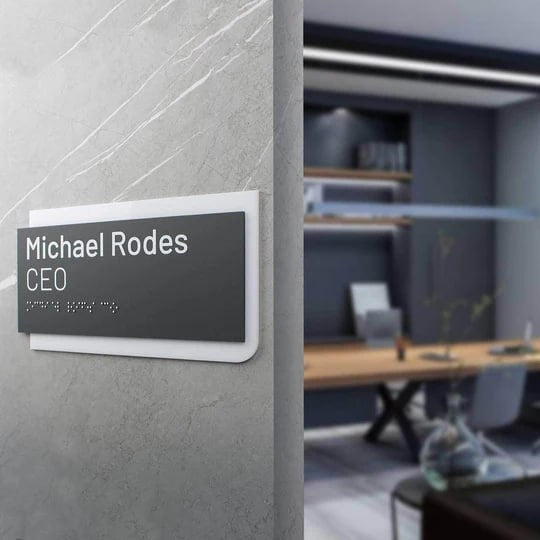
Room numbers, suite numbers, hotel or guest room numbers, and dwelling unit numbers in apartment buildings are all treated as permanent designations under §216.2, so once a property chooses to number and identify these units, the signs must include tactile characters and Braille. This applies to every guest room in a hotel and every dwelling unit in an apartment building, not just accessible units. One important exception: signs that display only an occupant's name — such as an employee nameplate — are exempt under §216.1, Exception 1, because they identify a person, not a permanent room function. A room number sign, however, is not exempt even if it sits next to a nameplate.
Mechanical, Electrical, and Utility Rooms
Mechanical, electrical, storage, and utility rooms are permanent spaces even if the public rarely enters them. Any identification sign provided for these rooms must comply with the same §216.2 requirements as other permanent room signs.
Which Rooms and Signs Do Not Require ADA Signs?
Building directories, menus, seat and row designations in assembly areas, occupant names, building addresses, and company names and logos are not required to comply with §216 (§216.1, Exception 1). Therefore, they do not need tactile characters or Braille under these provisions. In detention and correctional facilities, signs not located in public use areas are also exempt (§216.1, Exception 4).
Definition: Temporary sign — Signs used for seven days or less are exempt from the ADA signage requirements (§216.1, Exception 3).
Definition: Directional sign
Informational and directional signs fall under visual requirements only and do not need Braille (§216.3, §703.5). They must meet visual standards such as legible fonts, sufficient contrast, and appropriate character height. Businesses may add tactile elements voluntarily, but the ADA does not require them.
Permanent vs Temporary Room Identification
Table 2. Permanent vs Temporary Room Identification
| Criterion | Permanent room or space | Temporary space |
|---|---|---|
| Does the designated function persist over time? | Yes — fixed function | No — function or occupancy changes |
| Example | Restroom, stairwell, numbered office, mechanical room | Trade show booth, single-day event sign, pop-up display |
| Sign type typically used | Identification sign | Temporary or event sign |
| Tactile characters + Braille required? | Yes, if a sign is provided | No, if used 7 days or less (§216.1, Exception 3) |
| How the 7-day exception applies | Not applicable — room function is fixed | Sign is exempt if removed within 7 days |
| If the room's use changes | Room remains permanent; sign requirements unchanged | If use becomes permanent, treat the space as a permanent room going forward |
In ambiguous cases — a conference room used for different meetings each week, a hot-desking area, a temporary exhibit partition, or a classroom where the subject taught changes each semester — the test is the room's function, not what happens inside it on a given day. A conference room stays a permanent space even though its use varies hour to hour; a booth built for a three-day trade show does not, provided it comes down within the 7-day window.
ADA Requirements for Permanent Room Signs: What Applies Once a Sign Is Required
Once §216.2 applies to a room, the sign itself must comply with the technical requirements for ADA compliant door signs under §703, including tactile characters, Contracted (Grade 2) Braille (see when Braille is required on signs), high visual contrast, a non-glare finish, and proper mounting on the latch side of the door. You can also explore our collection of ADA Braille signs for examples of signs designed to meet these requirements.
Tactile characters must be mounted with the baseline of the lowest tactile character at least 48 inches above the floor and the baseline of the highest tactile character no more than 60 inches above the floor (§703.4.1). For more information, see our ADA sign mounting height requirements.
Industry Examples: Room-by-Room
Table 3. Industry Examples
| Building type | Rooms that need tactile signs | Typically visual-only or exempt | Relevant BSign Store collection |
|---|---|---|---|
| Office | Restrooms, individual offices, conference rooms, mechanical rooms | Building directory, employee nameplates | office door signs |
| Hotel | Guest room numbers, restrooms, stairwells, mechanical rooms | Lobby directional signage, menus | ADA Braille signs |
| Healthcare | Patient rooms, exam rooms, restrooms, mechanical/utility rooms | Wayfinding to departments, waiting area signage | ADA Braille signs |
| School | Classrooms, restrooms, stairwells, mechanical rooms | Building directory, temporary event signage | restroom signs |
| Commercial / mixed-use | Restrooms, stairwells, elevators, individual tenant suites | Building directory, storefront signage | ADA signs |
Offices and Coworking Spaces
ADA office signs are required for permanent spaces such as individual offices, conference rooms, and restrooms once identification signs are provided. Shared hot-desk areas without a fixed assignment generally do not require tactile identification signs, since no single desk carries a permanent designation.
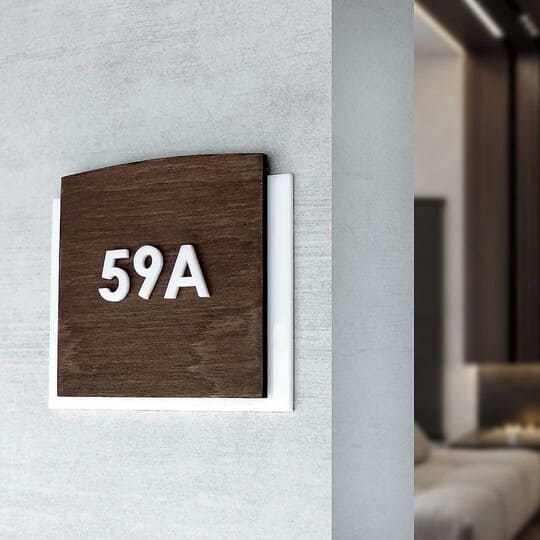
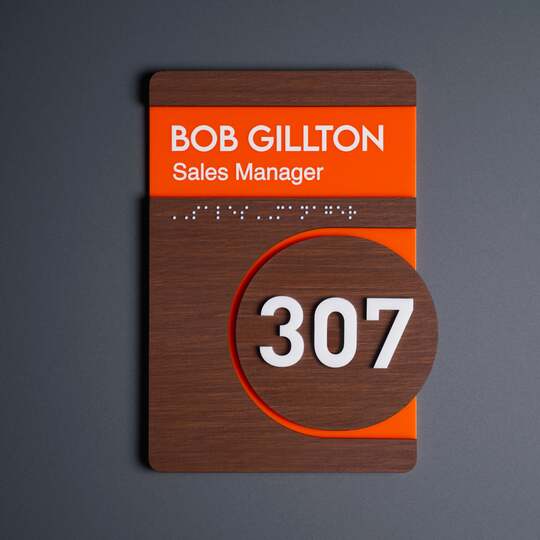
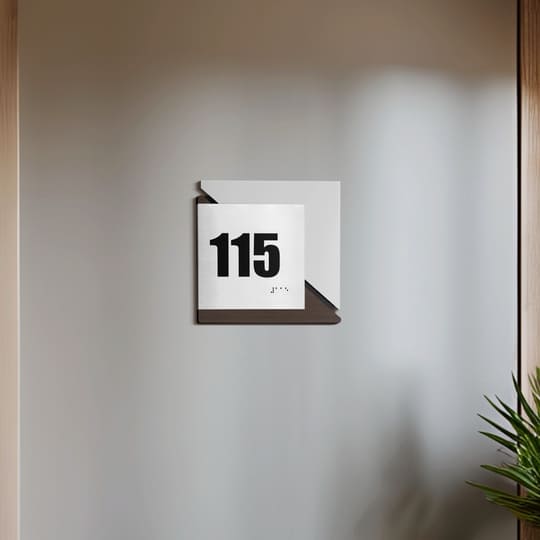
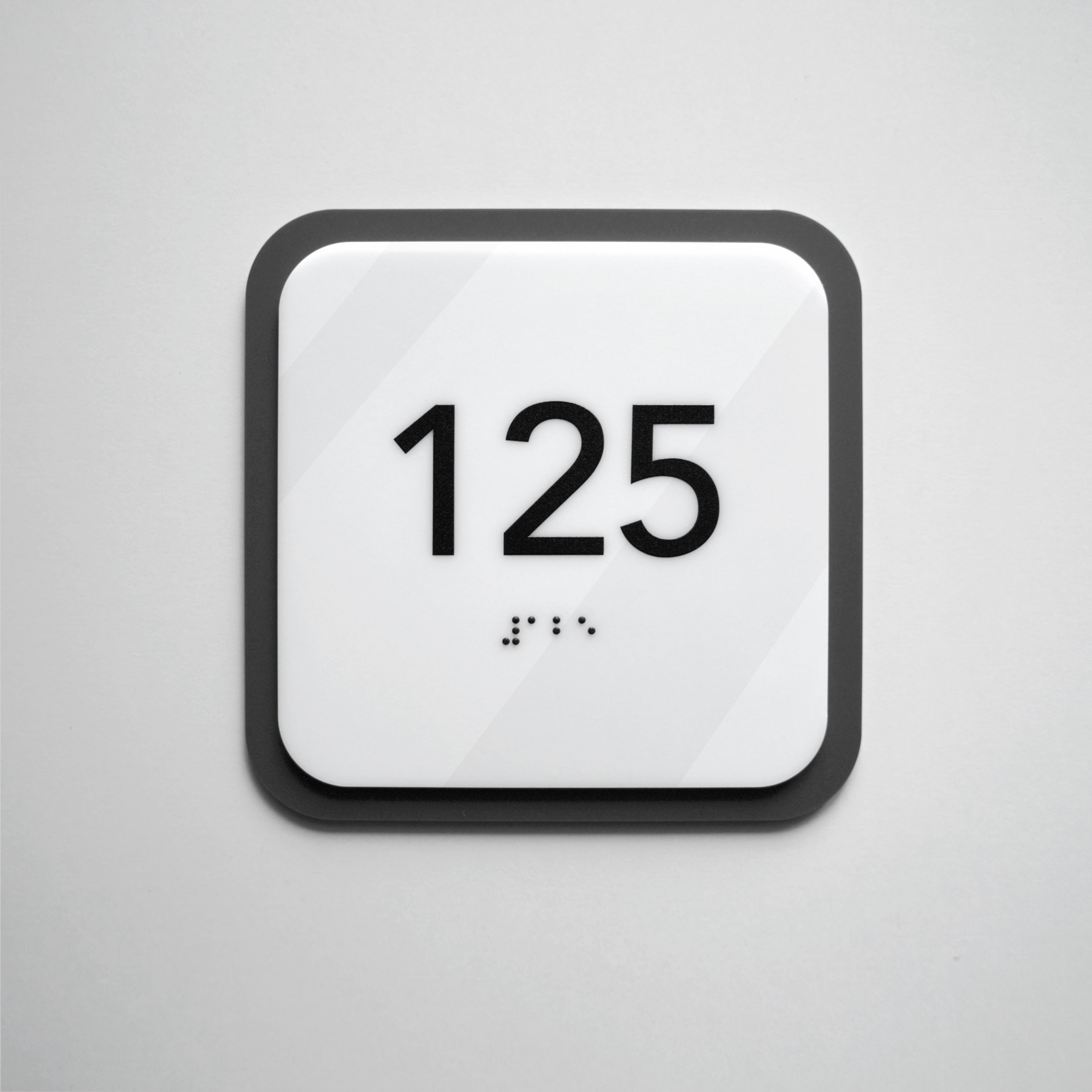
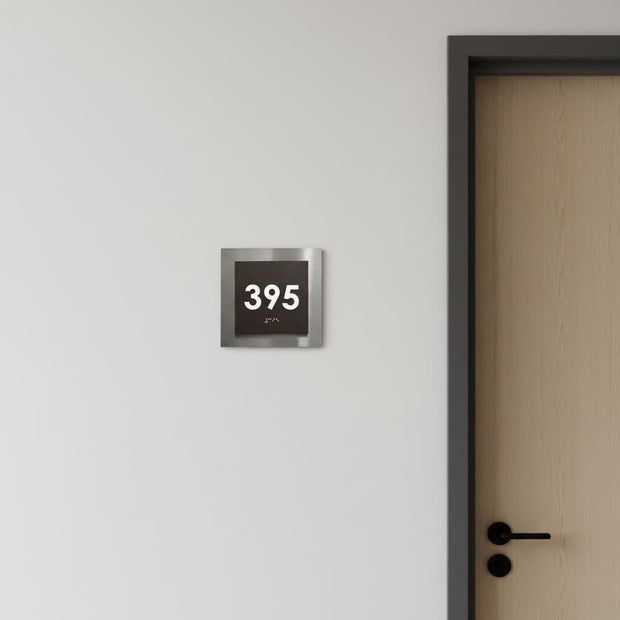
Room number sign installed on the wall beside the door handle side, showing tactile characters and Braille:
Hotels
ADA signs for hotel rooms are required because every guest room number is a permanent designation, so guest room signage throughout the property must include tactile characters and Braille. Lobby directional signage pointing toward the restaurant or elevators is visual-only. For hotel-specific guidance, see our article on ADA signs in hotels.
Healthcare Facilities
Patient rooms, exam rooms, and restrooms in hospitals and clinics are permanent spaces subject to §216.2. Departmental wayfinding signage — arrows toward radiology or the pharmacy — falls under the visual-only directional category instead. For more guidance on selecting compliant healthcare signage, see our guide to Braille signs for hospitals and schools.
Schools and Universities
ADA signs for schools are required for permanent spaces such as classrooms, restrooms, stairwells, and mechanical rooms once identification signs are provided. Classrooms keep their permanent designation even as the subject taught in them changes by semester, so classroom number signs need tactile characters and Braille. A temporary sign for a one-day event in the same room is exempt under the 7-day rule.
Commercial and Mixed-Use Buildings
Shared restrooms, stairwells, and elevators in a mixed-use building follow the same rules as any other property type, while individual tenant suite numbers are treated as permanent room designations that require tactile signage once posted. The same logic applies to residential and apartment buildings: dwelling unit numbers are permanent designations under §216.2, so every unit door number needs a tactile and Braille sign once the building posts unit numbers, not only units designated as accessible.
Common Mistakes When Deciding Which Rooms to Sign
- Adding Braille to every sign in a building, including directories and directional signage, where it is not required.
- Providing a visual-only identification sign for a permanent room when §216.2 requires tactile characters, Braille, and applicable visual features.
- Mounting a tactile sign on the door without confirming that the §703.4.2 exception applies.
- Confusing identification signs (regulated under §216.2) with directional or informational signs (visual-only under §216.3).
- Overlooking stairwell floor-level signage and elevator landing signage.
- Relying only on the federal ADA signage guidelines without checking applicable state or local accessibility codes, which can add requirements.
ADA Room Signage Checklist
Table 4. ADA Room Signs Audit Checklist
| Step | Question | If yes | If no |
|---|---|---|---|
| 1 | Have you listed every room and space in the building? | Proceed to step 2 | Complete the inventory before continuing |
| 2 | Which rooms have a permanent, fixed function? | Treat as a permanent room — go to step 3 | Treat as temporary; check the 7-day rule |
| 3 | Does the room involve an exit door, stairwell, or floor level? | Tactile EXIT / floor-level sign required (§216.4.1) | Continue to step 4 |
| 4 | Is it a restroom or bathing room? Are all facilities accessible? | If not all are accessible, add ISA + directional signage | Continue to step 5 |
| 5 | Is the sign directional or informational rather than identifying a room? | Visual requirements only apply (§216.3) | Continue to step 6 |
| 6 | Does the sign fall under an exemption (directory, nameplate, ≤7-day temporary sign)? | No ADA sign requirement applies (§216.1) | Continue to step 7 |
| 7 | Does the required sign meet §703 (tactile, Braille, contrast, mounting)? | Sign is compliant | Review our checklist article before installation |
Key Takeaways
- The 2010 ADA Standards regulate identification signs for permanent rooms and spaces once such signs are provided (§216.2). They do not require a sign on every door.
- Exit doors require tactile EXIT signage where specified by the ADA Standards (§216.4.1).
- Stairwells must include tactile floor-level identification signs to indicate the floor, stair designation, and the top and bottom terminus of the stairway.
- Directional and informational signs only need to meet visual requirements, no Braille (§216.3, §703.5).
- A permanent room or space is one whose designated function does not change over time, regardless of what is currently inside it.
- Building directories, occupant nameplates, and signs used for seven days or less are exempt from ADA signage requirements (§216.1).
- Hotel guest rooms, office numbers, and suite numbers are all treated as permanent designations that require tactile signage once posted.
BSign manufactures ADA compliant room signs, including tactile and Braille identification signs for offices, hotels, healthcare facilities, schools, and other commercial buildings. If you're planning a new project or auditing an existing property, our team can help you choose signage that meets your project requirements. Browse our ADA signs collection or contact us for a consultation.
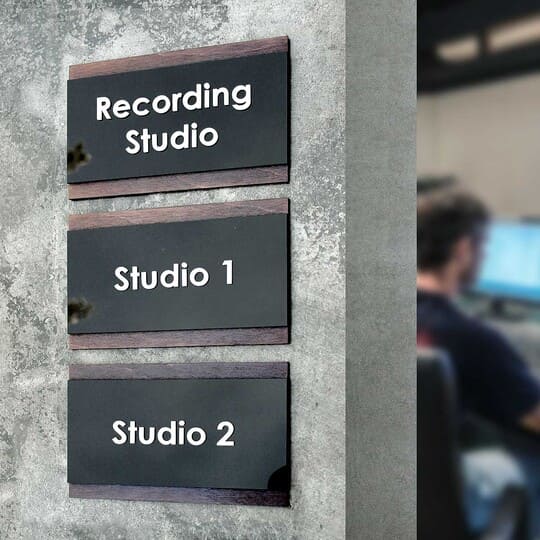
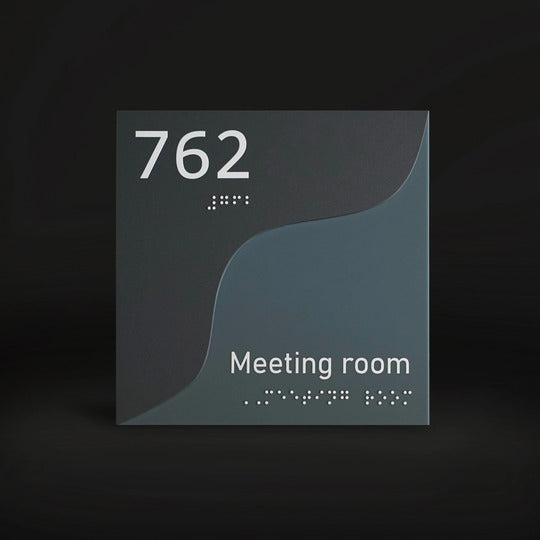
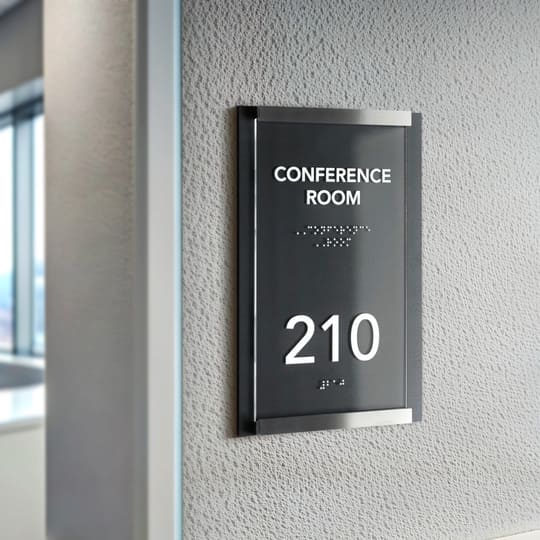
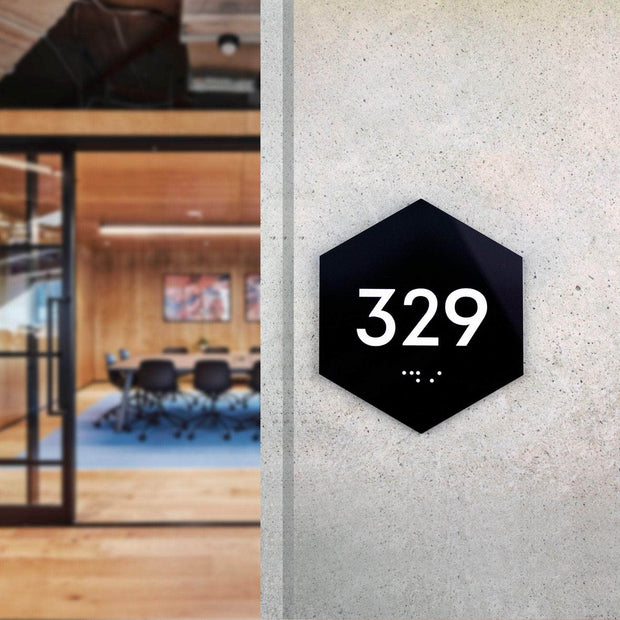
Room number sign featuring raised characters and Braille, installed on the wall next to a conference room entrance:
FAQ
Which rooms require ADA signage?
No — not all rooms need ADA signs. Permanent rooms and spaces — restrooms, stairwells, mechanical rooms, and numbered offices or hotel rooms — require tactile and Braille identification signs if an identification sign is provided (§216.2). Exit doors require tactile EXIT signage outright. Directional and informational signs only need to meet visual requirements.
Do office doors need ADA signs?
Room numbers must comply with tactile and Braille requirements once posted, since they identify a permanent space. Signs that show only an employee's name are exempt under §216.1, Exception 1, because a nameplate identifies a person, not the room itself.
Do conference rooms need ADA signs?
Not every conference room must have an identification sign under the ADA Standards. When such a sign is provided, it must meet the tactile and visual requirements of §216.2 and §703. Temporary notices used for seven days or less are exempt under §216.1, Exception 3.
Are restroom signs mandatory?
The ADA Standards do not generally require an identification sign for every restroom. When such a sign is provided, §216.2 applies. Separately, §216.8 requires ISA identification and visual directional signs in certain situations involving inaccessible or clustered toilet and bathing facilities.
Which hotel rooms require ADA signage?
Every guest room number in a hotel is a permanent designation under the ADA Standards, so all guest rooms — not only accessible units — need tactile and Braille room number signs once the property posts room numbers.
What rooms are exempt from ADA signage?
Building directories, menus, seat and row designations, occupant nameplates, building addresses, and company names or logos are exempt under §216.1, Exception 1. Signs used for seven days or less are also exempt under Exception 3.
What makes a room permanent under the ADA?
The 2010 ADA Standards do not define a permanent room as a standalone term. The U.S. Access Board explains that §216.2 applies to room names, numbers, and other designations that are unlikely to change over time, such as restrooms, stairwells, or numbered offices. As a practical rule of thumb, spaces with fixed functions are commonly treated as permanent, even if the activities taking place inside them vary over time.
Do temporary signs need to comply with the ADA?
Signs used for seven days or less are exempt from ADA sign requirements under §216.1, Exception 3. If a sign is used longer than seven days, its requirements depend on what type of sign it is under §216 — an identification sign for a permanent room still needs tactile characters and Braille.


