










by Olena Zadniprovska
Restroom Signs in 2026: Accessibility, Design, and Requirements That Can’t Be Ignored
Modern restroom signs are navigation elements that combine clear pictograms, readable text, and tactile features to ensure quick orientation and compliance with accessibility requirements.
They perform three main functions:
-
• provide instant room identification;
-
• support inclusive navigation for different users;
-
• integrate into the overall building wayfinding system.
In 2026, they have become part of a building’s navigation logic, a tool of inclusivity, and a marker of spatial quality. This is especially relevant in situations where restroom navigation in public spaces must be intuitive without explanation, and solutions must comply with accessibility requirements and modern spatial standards.
Today, restrooms are spaces that almost every visitor uses. If a person hesitates about where to go, searches for signage, or has to ask staff for directions, it signals insufficiently developed navigation. That is why restroom signage directly influences the overall impression of a facility — whether there are business centers, hotels, healthcare facilities, or any other space with a constant flow of people.
Public restroom signage influences the speed of visitor orientation, while in business environments, they affect brand perception, attention to detail, and respect for different user groups.
In this article, we will examine:
-
• the role signage plays in a building’s overall navigation system;
-
• the difference between pictograms and text-based solutions, and when it is appropriate to combine them;
-
• which accessibility recommendations have become fundamental in 2026;
-
• what are the best materials for restroom signs;
-
• why properly organized restroom wayfinding became a criterion of facility quality.
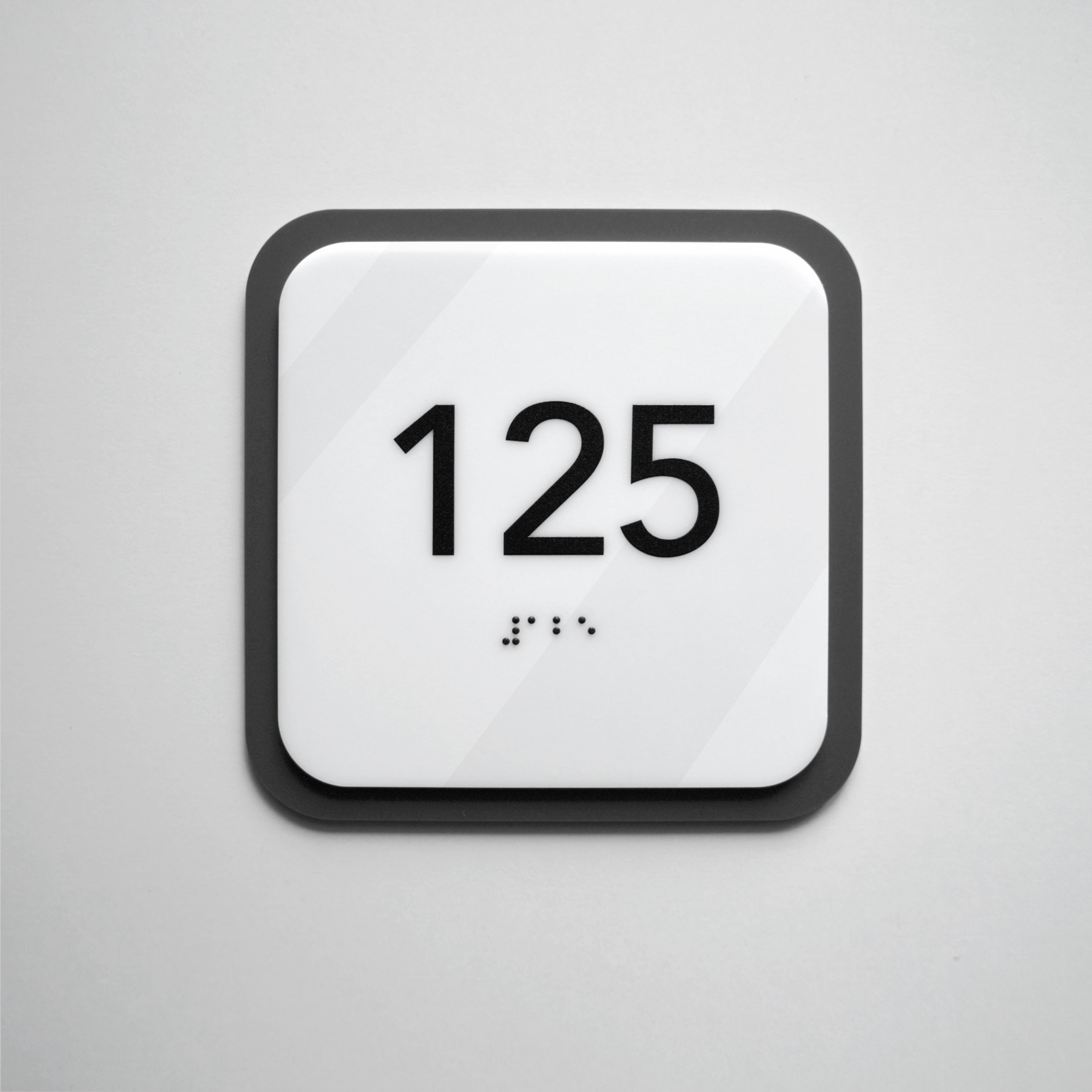
A high-contrast restroom plaque with tactile elements in a modern interior:

What a Modern Restroom Sign Should Include
A modern restroom signage design should:
-
• have high contrast;
-
• include a clear pictogram;
-
• feature tactile elements;
-
• comply with accessibility regulations;
-
• be installed at the correct height.
These requirements align with international ISO standards and current national building regulations on accessibility. Compliance ensures not only formal conformity but also real usability of the space.
Restroom Signs: Their Role in the Navigation System
In modern buildings, route logic determines how quickly a person can orient themselves, how comfortable they feel inside the facility, and whether they need to ask for assistance. Within this logic, restroom navigation elements serve a much broader role than simply labeling doors. They become part of the overall spatial logic, where each element supports a clear and understandable route.
Why restrooms are key wayfinding points in buildings
Restrooms are one of the most frequently requested locations in any building. It is a space used by virtually every visitor, regardless of the facility type. If a visitor cannot quickly locate it, this creates tension and negatively affects the user experience in physical spaces. Even a few extra minutes spent searching can create a sense of chaos or insufficient planning.
That is why the route to restrooms requires clear logic and understandable solutions. It should be intuitive, allowing a person to follow the path and read the signage without hesitation. Special attention should be given to accessibility, as Braille signage for inclusive facilities and public centers is now a mandatory standard that ensures equal access for all visitors. If the system is overloaded or inconsistent, navigation loses its effectiveness.
How restroom signs work within a broader wayfinding system
High-quality restroom products function within a unified navigation system — together with directional signage, floor maps, and circulation routes. Each element supports the others, creating a continuous orientation chain.
It is important that the style, typography, materials, and mounting methods are consistent. This ensures cohesive spatial orientation and eliminates conflicting signals. If signage differs from other navigation elements, visual inconsistency arises, reducing overall effectiveness.
How navigation quality affects user perception of space
A well-designed route logic builds trust. When a visitor easily finds the desired location, they perceive the space as organized and professional. This is especially important in facilities with high visitor flow.
In commercial environments, this directly influences loyalty. Details such as restroom signage contribute to the perception of quality — even if their presence seems subtle.
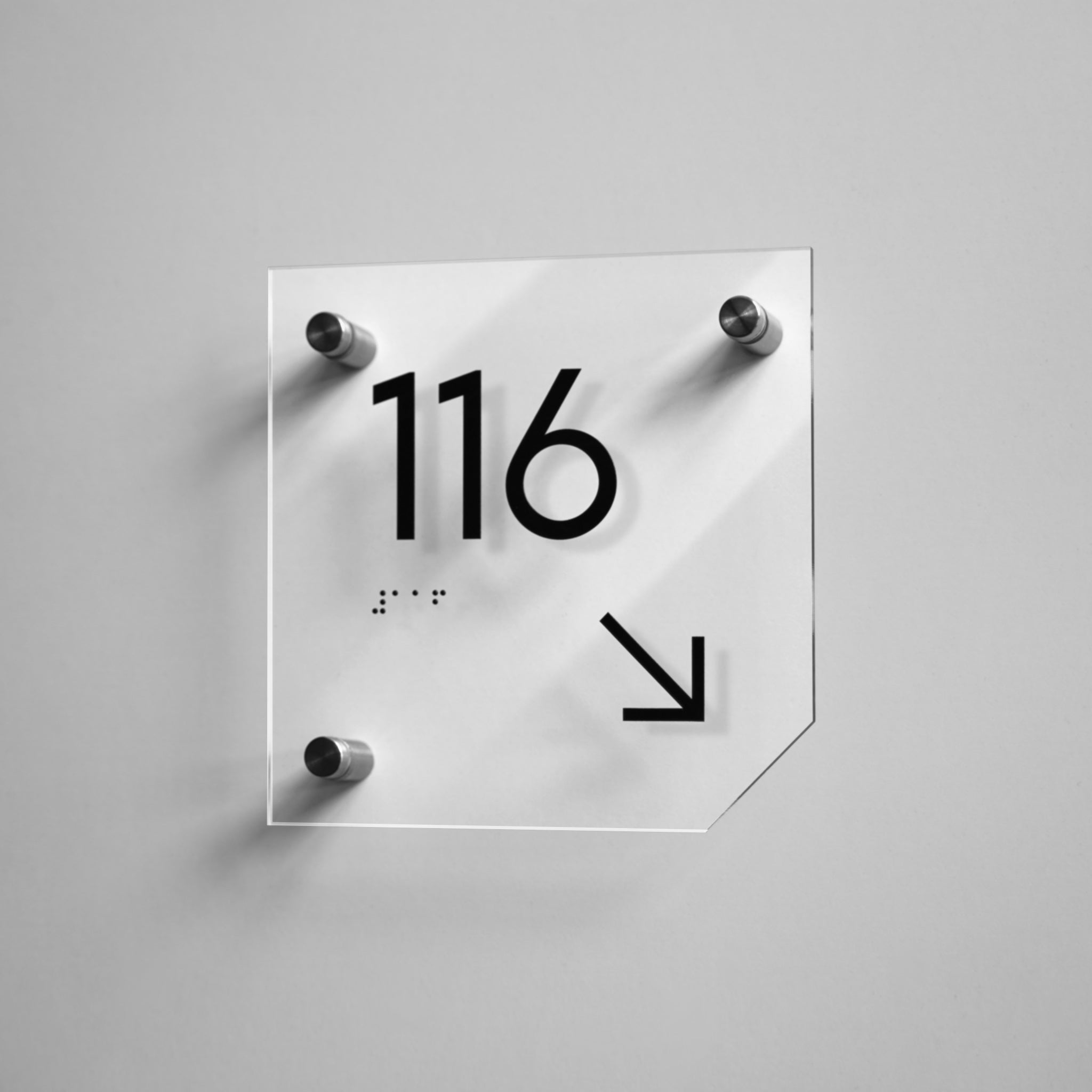
A restroom directional plaque with clear typography and arrow navigation:

Core Functions of Restroom Signage in Public and Commercial Spaces
The functionality of navigation is determined not by the number of elements, but by their clarity and logical structure. Washroom signs perform several tasks simultaneously: they help users quickly locate the required facility, reduce the navigation burden on staff, and support the overall structure of the space.
Clear Identification Without Additional Explanations
Restroom signs must be readable within seconds. A clear pictogram or concise text ensures immediate understanding without the need to stop or look closely. A person should make a decision intuitively, without analyzing complex wording or overloaded symbols.
Contrast, sufficient font size, and proper placement on or next to the door are crucial. If the plaque is unclear or blends into the wall, the function of quick identification is lost.
Navigation for Different Types of Users
A building simultaneously accommodates people of different ages, languages, and physical abilities. That is why universal solutions are essential. Wayfinding must be clear both for regular visitors and for those entering the space for the first time.
A thoughtfully designed product format takes into account various usage scenarios. A concise form, an unambiguous symbol, and clear text minimize the risk of misinterpretation. This approach reduces the number of incorrect entries and creates a sense of order.
Visual consistency within the built environment
In commercial spaces, signage should be integrated into the overall interior logic. Materials, colors, and form should support the style rather than disrupt it. If navigation elements appear random, they undermine the cohesion of the visual environment.
At the same time, excessive decoration is inappropriate. A plaque should remain a functional element that complements the space rather than competes with it. The balance between practicality and aesthetics defines the quality of the solution and influences the overall perception of the facility.
A matte black sign with contrasting male and female pictograms and Braille text for accessible navigation:

Pictograms vs Text-Based Restroom Signage: What Works Better and When
The choice between a symbol and text is a matter of functionality. In modern facilities, the decision is made based on the type of space, visitor flow, and the required speed of orientation.
Why pictograms are widely understood across different user groups
Pictograms are quickly understood regardless of language. That is why they are a fundamental tool in public buildings with high visitor traffic. People perceive graphic symbols faster than text, so in situations where speed is essential, pictograms are more effective.
In international or multilingual environments, symbols eliminate the need for additional explanations. This reduces cognitive load and speeds up decision-making.
When text-based signage improves clarity
Text is appropriate when precise wording or additional clarification is required. For example, in bathroom signs, text can specify accessibility, gender-neutral use, or additional functional details.
Text-based solutions are also suitable for spaces with low visitor flow, where speed of orientation is not a critical factor. At the same time, it is important to keep wording concise to avoid overloading the navigation element with unnecessary information.
Why combined solutions are becoming the 2026 standard
Combining a symbol with text is the optimal approach. It meets modern navigation requirements and enhances readability. The symbol ensures instant recognition, while the text clarifies the meaning.
Pictograms and text convey information in different ways. A pictogram communicates meaning through a graphic plaque and is perceived intuitively, while text provides an exact verbal definition of a room’s function. In complex facilities, a combined format minimizes orientation errors and increases user confidence.
A children’s restroom sign with simple pictograms designed for intuitive recognition:

Accessibility as a Mandatory Requirement, Not an Optional Feature
Modern accessibility standards require wayfinding systems to consider the needs of all users. Accessible signs are a mandatory component of a barrier-free environment. The absence of thoughtful solutions limits some visitors’ ability to navigate the space independently.
Who accessible restroom signage is designed for
Inclusive solutions are intended for people with visual impairments, mobility limitations, as well as first-time visitors. Accessibility means the ability to obtain information without outside assistance.
Inclusive design must function effectively across different usage scenarios. It increases visitor independence and reinforces a sense of respect for every individual.
Tactile elements as functional navigation tools
Tactile restroom signs include raised symbols and text. Tactile elements allow information to be read by touch and are essential for people with visual impairments.
The relief must be sufficiently pronounced to ensure comfortable reading. At the same time, the shape and size of the symbols should remain clear for visual perception as well.
When Braille restroom signs are required
In most public facilities, restroom signs with Braille are mandatory, as regulations require accessibility for essential spaces.
ADA restroom signs ensure wayfinding for people with visual impairments and comply with principles of equal access.
Proper placement and mounting height of restroom signs
Not only materials are important, but also proper positioning. Installation at the correct height and on the handle side of the door aligns with inclusive design principles and ensures convenient access for reading.
To make ADA compliant restroom signs accessible, it is necessary to combine a clear pictogram, sufficient contrast, raised text, and correct mounting height. This comprehensive approach ensures compliance with accessibility guidelines and provides convenience for all users without exception.
A restroom plaque for people with disabilities featuring a wheelchair symbol and a tactile surface for inclusive navigation:

Inclusive Wayfinding Principles for Restrooms in Public and Commercial Spaces
These principles are based on simplicity, clarity, and respect for user diversity. A space should be understandable without additional explanations and without requiring adaptation for specific groups of people.
Neutral and intuitive design for an inclusive wayfinding
Inclusive navigation avoids complex forms, decorative details, and overloaded solutions. Minimalism ensures quick perception and reduces the risk of misinterpreting symbols.
A concise composition, clear contours, and a limited number of elements allow a person to focus on what matters most. Simplicity does not mean reducing functionality — it means eliminating anything that may interfere with orientation.
Avoiding visual and symbolic ambiguity
Symbols must be understandable without additional explanation. If a navigation element requires decoding, it does not fulfill its function.
Clarity is achieved through the use of widely recognized graphic forms and logical placement of elements. This is especially important in spaces visited by people with different cultural and linguistic backgrounds.
Designing for the widest possible audience
The principle of universal design involves creating solutions that serve the widest possible audience without the need for additional adaptation. Navigation should be equally convenient for people of different ages, physical abilities, and levels of familiarity with the space.
This approach reduces barriers, increases user independence, and ensures the long-term relevance of the solution.
An acrylic all-gender restroom sign with stainless steel mounts in a modern interior:

Gender-Neutral Restroom Signage: Where and Why It Makes Sense
Such signs indicate that a restroom can be used by both men and women. Most often, this refers to universal restrooms or individual-use facilities. In these cases, there is no need to divide the space into "male" and "female," as functionally it is shared.
This approach simplifies navigation, reduces the number of visual elements, and eliminates duplication of signage.
Spaces where gender-neutral signage is appropriate
Gender-neutral restroom signage is suitable for modern offices, cultural spaces, and educational institutions. In such spaces, it is important to create an atmosphere of openness and respect for different users.
The decision to use neutral labeling is made based on the type of space, its function, and the expectations of its audience.
How gender-neutral signage simplifies wayfinding
In smaller facilities, a universal sign reduces the number of labels and simplifies orientation. Users do not need to choose between multiple options when the space is functionally shared.
This approach also helps avoid duplication of navigation elements and supports a logical spatial structure.
Clear visual language without over-symbolization
Concise symbols and clear typography create an understandable visual language. It is important to avoid excessive detailing that complicates perception.
A balanced composition, correct proportions, and sufficient contrast allow for the creation of a neutral yet expressive product that works effectively in any interior.
A gender-neutral restroom sign with balanced typography and clear universal symbols:

Restroom Sign Design Trends for 2026
Modern design combines functionality and aesthetics. A solution must ensure clarity while also supporting the character of the interior.
The shift from graphic icons to tactile solutions
Raised elements have become a standard in public buildings. The combination of a graphic symbol, text, and tactile details allows different modes of information perception to be addressed.
Restroom signs as an integrated part of interior design
Materials should support integration into interior design and not appear random. The shape, thickness, mounting method, and surface finish must align with the overall spatial concept.
When a plaque harmoniously complements its environment, it reinforces a sense of cohesion and thoughtful detailing.
Legibility, restraint, and long-term clarity
Readability is achieved through contrast, sufficient font size, and simple forms. Excessive decoration reduces functionality and complicates perception.
A restrained approach makes it possible to create a solution that remains relevant for many years and meets the requirements of contemporary spaces.
A wooden restroom sign with engraved lettering that highlights the natural texture of the material:

Materials as Part of the Wayfinding and Tactile Experience
The choice of materials affects durability, readability, and the overall perception of a space. Selecting the base for a navigation element determines how it performs under daily use, how it responds to contact, and whether it maintains its appearance over the years.
Materials shape the tactile experience and reinforce the function of the sign. Surface texture, thickness, finishing method, and mounting influence the perception of quality. That is why material selection is not decorative — it is part of the navigation strategy.
Wood and its impact on spatial perception
Wood adds warmth and natural character. It softens the visual environment and creates a sense of comfort, which is especially important in spaces where people spend extended periods of time.
Wooden elements are appropriate where it is necessary to maintain a balance between functionality and emotional perception. When combined with clear graphics, wood supports a restrained aesthetic while remaining a practical material for navigation solutions.
Metal in high-traffic public environments
Stainless steel provides strength and durability in high-traffic areas. It is resistant to mechanical impact and maintains a neat appearance even under intensive use.
In public spaces with a large flow of people, metal solutions demonstrate stability and reliability. They emphasize the systematic nature of the environment and meet durability requirements.
A stainless steel restroom sign designed for public areas with high foot traffic:

Acrylic as a modern navigation material
Acrylic makes it possible to create clean shapes and dimensional lettering. Thanks to precision processing, it ensures a neat appearance of symbols and text.
This material is appropriate for contemporary interiors where clarity of lines and geometric precision are essential. Acrylic elements pair well with wood and metal, creating balanced navigation solutions.
Restroom Signage as an Indicator of Overall Space Quality
Wayfinding elements are often perceived subconsciously. People do not analyze them separately, yet they shape the sense of order. Public restroom signage is part of this process and demonstrates the level of attention to detail.
Why navigation details build trust subconsciously
Even small elements influence the overall impression. If a navigation element is neatly executed, features clear graphics, and is made of quality materials, the space is perceived as thoughtfully designed.
Conversely, random or temporary solutions create a sense of carelessness. Trust is built through consistency and a systematic approach to details.
Restrooms as a benchmark for spatial standards
The condition and design of restrooms reflect the management approach of the facility. If navigation is logical and signage is well executed, it indicates attention to the fundamental needs of users.
In many cases, the restroom area becomes an indicator of the overall standard of the space. It demonstrates whether there is a balance between functionality and aesthetics.
Signage that works quietly but consistently
High-quality restroom directional signs perform their function without drawing unnecessary attention. They do not overload the space or compete with the interior, yet they ensure quick information recognition.
When the route logic works seamlessly, users do not think about the search process. This is the true plaque of a well-considered solution — the space becomes clear without additional effort.
An acrylic restroom sign with clean geometric lines and a matte finish:

Restroom Wayfinding in Public Spaces: Conclusion
Wayfinding has become an indicator of systematic organization, regulatory compliance, and respect for users. If a person can find the restroom effortlessly, does not need to ask clarifying questions, and does not hesitate in front of the door, the navigation system is working properly.
Modern wayfinding requirements include:
-
• barrier-free access;
-
• clarity and unambiguity;
-
• logical route planning.
Accessible signs must be readable, high-contrast, positioned at the correct height, and supplemented with tactile elements where required by regulations.
If you are planning to upgrade a navigation system or design a new space, it is important to consider all regulatory and functional aspects at the development stage. Consulting with Bsign specialists will help prevent mistakes in placement, material selection, and accessibility compliance, while ensuring a solution that performs effectively and is long-term.
Frequently Asked Questions
Why are restroom signs needed in public spaces?
They ensure quick orientation, reduce the navigational burden on staff, and enhance visitor comfort.
Are tactile signs with Braille mandatory?
In most public facilities, yes. Accessibility requirements established in building regulations and supported by ISO standards provide for access to essential premises.
What should be the mounting height of a sign?
Signs are installed at a height convenient for both tactile and visual reading, typically next to the door handle.
What materials are used for restroom signs?
Wood, metal, and acrylic are most commonly used, depending on operating conditions and durability requirements.
When are gender-neutral signs appropriate?
They are used for universal restrooms or individual stalls intended for all users.


